


When it comes to jobs, San Francisco Board of Supervisors President David Chiu is putting his political stock in high tech. Until he and Mayor Ed Lee teamed up to keep Twitter and other information companies in the city, he said, “San Francisco was the least inviting city for tech innovation.”
Category: City Hall

Posted inCity Hall, Earthquakes, Housing, Public Safety, Technology
Potentially Earthquake-Unsafe Residential Buildings — a (Very Rough) List

This story appeared in the Winter 2012-2013 print edition of the San Francisco Public Press.
San Francisco’s Department of Building Inspection has kept a preliminary list of potentially dangerous soft-story buildings since 2009, but inspectors say it has not been verified by actual building inspections, and was never intended for public consumption. Some of the addresses the city generated might be wrong. The Public Press is publishing the list so that residents who might possibly be at risk in their homes can participate in the debate over how best to retrofit thousands of properties in coming years.

Posted inCity Hall, Earthquakes, Housing, Land use, Public Safety, Technology
Earthquake Retrofit Delays Leave Thousands at Risk

It will take at least 7 years to secure older wood buildings dangerously perched above windows or garages
This story appeared in the Winter 2012-2013 print edition of the San Francisco Public Press.
One in 14 San Franciscans lives in an old building with a first floor that city inspectors say could be vulnerable to collapse if not retrofitted soon to withstand a major earthquake.While officials have had a preliminary list of nearly 3,000 suspect properties for more than three years, they have not told landlords, leaving the estimated 58,000 residents who live there ignorant that their buildings could be unstable.
Posted inArts & Culture, City Hall, Government & Politics, Homelessness, News
‘Homeless Bill of Rights’ Seeks Legal Protections for Those on the Streets

A new push for a statewide “Homeless Bill of Rights” could lead to free legal representation for anyone citied under laws such as San Francisco’s sit-lie law or anti-panhandling ordinance. Assemblyman Tom Ammiano, D-San Francisco, introduced Assembly Bill 5, as a response to what he said was a national trend of enforcing laws on public […]

Posted inCity Hall, Community, Social Justice
San Francisco to Pilot Participatory Budgeting
Residents in San Francisco’s northeastern corner will soon get a say in how a small piece of San Francisco’s budget is spent improving their neighborhood. Supervisor David Chiu announced last week that residents of District 3, which includes North Beach, Chinatown and part of the Financial District, could vote on how to spend $100,000 in discretionary funds. It’s part of a civic innovation called participatory budgeting, with the money earmarked for one-time community projects.

Posted inCity Hall, Land use, Muni, Neighborhoods, Transportation
A Central Subway North Beach Station? Not So Easy, Planners Say

A proposal to pull out tunnel-digging machines in North Beach has spurred debate about the prospect of building additional stations to extend the Central Subway project north of Chinatown. But transit officials say that’s not in the current plans, and such a move would take years more planning.

Posted inCity Hall, Muni, Transportation
Muni May Use Extra Funds on Fast Passes for Low-Income Youth, Maintenance
San Francisco transit director Ed Reiskin wants to use $6.7 million in extra regional transportation funds for a 12-month pilot program to hand out free Fast Passes to the city’s low-income youth and to rehabilitate light-rail vehicles.

Posted inCity Hall, Neighborhoods
Alexandria Theater Site Could Get New Life
The dilapidated Alexandria Theater might actually get renovated by early next year, saving at least the facade of the Richmond District landmark. But the new building would not look much its predecessor on the inside, with entertainment giving way to needed housing and retail.

Posted inArts & Culture, City Hall, Education, Elections
Budget Woes Threaten Free Lifelong Learning Classes at City College

Free courses could be beyond the reach of many “lifelong learning” students under changes proposed by City College of San Francisco’s leadership. The courses, which have been free for 30 years, could end up becoming fee-based as the college struggles to keep its accreditation by resolving looming budget deficits.

Posted inCity Hall, Elections, News
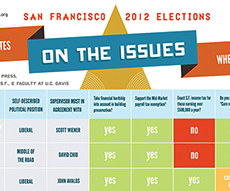
 Where do they stand? We asked. A nonpartisan guide to the candidates’ political positions
Board of Supervisors Candidates on the Issues: San Francisco Fall 2012 Election
 Where do they stand? We asked. A nonpartisan guide to the candidates’ political positions
Many observers complain about a lack of attention to the issues in city elections. It can be difficult for journalists, civic organizations and community groups to pin down exactly where the candidates stand on San Francisco policy disputes. Many of the candidate surveys distributed by news organizations and interest groups are limited because the questions permit evasive answers, focus on a narrow range of issues, or the candidates’ responses are not released to the public.
This issue-positions questionnaire for Board of Supervisors candidates in the November 2012 elections is largely based on recent divided votes of the board, covering the full gamut of San Francisco policy disputes, not just issues of concern to one or two groups.