


Orchid Pusey, interim director of the Asian Women’s Shelter in San Francisco, says cultural differences can have a big influence on the attitudes and responses to domestic violence. She talked with San Francisco Public Press reporter Ruth Tam about the challenges facing service providers in the city. This story appeared as part of a special report on domestic violence in the Fall 2012 print edition of the San Francisco Public Press.
Category: Public Safety

Posted inCity Hall, Domestic Violence, Law & Justice, News, Open Government, Public Safety, Social Justice, Social Services
Mirkarimi Case Brought Spotlight to Domestic Violence in San Francisco

As the city’s Ethics Commission debated whether Sheriff Ross Mirkarimi was fit to hold his elected position this past June, the complex game of personality, politics and procedure eclipsed larger policy questions about the city’s approach to handling thousands of cases of domestic violence each year. But advocates for victims said the hearings generated wider awareness of the problem of domestic violence.

Posted inCity Hall, Domestic Violence, Public Safety
District Attorney to Examine Low Prosecution of Domestic Violence Cases in San Francisco

San Francisco District Attorney George Gascón said he is looking into why office’s prosecutions for domestic violence crimes was the lowest per capita in the Bay Area. His remarks came after a special report in the San Francisco Public Press on the handling of such cases by police and prosecutors.
Posted inNews, Public Safety, Social Justice
KQED Radio Interview: Public Press Domestic Violence Report

Editors’ note: This report aired on KQED News on Sept. 26, 2012. KQED’s STEPHANIE MARTIN: A new investigative reporting series is questioning San Francisco’s record in tracking and prosecuting domestic violence cases. The investigation by KQED News Associate S.F. Public Press found the District Attorney’s Office prosecutes fewer domestic violence cases per capita than any […]

Posted inCity Hall, Law & Justice, Public Safety, Social Justice
Poor Record Keeping Hinders Analysis of Domestic Violence Policing Practices

As statistics go from tick marks to laptops, police struggle to make sense of trends
The San Francisco Police Department cannot precisely measure the number of domestic violence cases it handled before 2011, because investigators in the Special Victims Unit hand-tallied monthly records, and used changing and inconsistently understood categories of crimes. This story appeared as part of a special report on domestic violence in the Fall 2012 print edition of the San Francisco Public Press.

Posted inDomestic Violence, News, Public Safety, Social Justice
San Francisco Trails Bay Area in Domestic Violence Prosecutions
Far fewer charged than across the region, even with strongly worded ‘no-drop’ guidelines
Though San Francisco’s so-called “no-drop” policy requires pressing domestic violence charges when evidence is sufficient to convict, the District Attorney’s Office pursued just 28 percent of cases through to trial or plea bargaining over the last 6 years. This story appeared as part of a special report on domestic violence in the Fall 2012 print edition of the San Francisco Public Press.

Posted inArts & Culture, Domestic Violence, Public Safety, Social Services
Different Person, Different Life: A Survivor’s Account of Domestic Violence in San Francisco

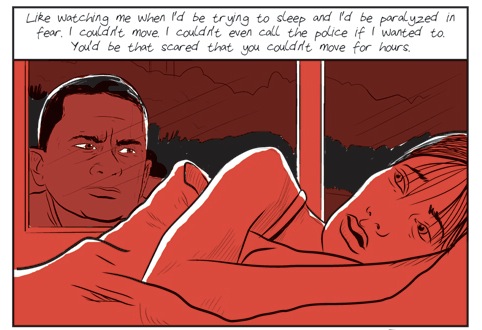 An illustrated account of one domestic violence survivor’s story of abuse and rescue in San Francisco, which appears in the Fall 2012 print edition of the San Francisco Public Press. Dan Archer did the illustration and reporting, with reporting and research help by Ruth Tam.

Posted inHuman Trafficking, Immigration, Labor, Law & Justice, Public Safety
Without long-term support, human trafficking survivors at risk of re-exploitation

Some who flee captive labor conditions end up with low-wage jobs, insecure housing
People trafficked into the country receive temporary government and nonprofit social service benefits after rescue or flight from captivity: shelter, health care, counseling, employment and legal help. But once these benefits term out, counter-trafficking specialists worry that victims, who generally have little work experience and weak social and family networks, could fall back into labor conditions as exploitative as the ones they fled. As a victim of international labor trafficking, Lili Samad received government help to stay in the U.S. But she is among hundreds of trafficking survivors each year who end up, months after getting help trying to build a new life, living in marginal housing and working in low-wage jobs.

Posted inCity Hall, Labor, Law & Justice, Public Safety
San Francisco police chief to be nation’s highest paid, for overseeing 14th-largest force
By the end of September, when he receives a scheduled raise, San Francisco Police Chief Greg Suhr will be the highest paid police chief in any major American city. A review of the police departments in the 60 largest cities in California and 24 of the largest police forces across the country found that Suhr’s annual salary of over $307,450 will push Suhr’s pay just beyond that of the Los Angeles chief.

Posted inArts & Culture, City Hall, Community, Homelessness, Neighborhoods, Public Safety
Most Haight merchants say nothing changed on street after ‘sit-lie’ prohibition

A majority of retailers surveyed last November in the Haight-Ashbury neighborhood said the enactment of San Francisco’s sit-lie law hasn’t worked as expected: Homeless people still hang out in front of their businesses. An independent research report commissioned by the city found that 58 percent of the merchants in the district — the focus of a political battle that led to voter approval of the ban in 2010 — say the same number of people or more continue to park themselves on sidewalks. Sixty-one percent said they encountered sidewalk sitters at least three times per week.